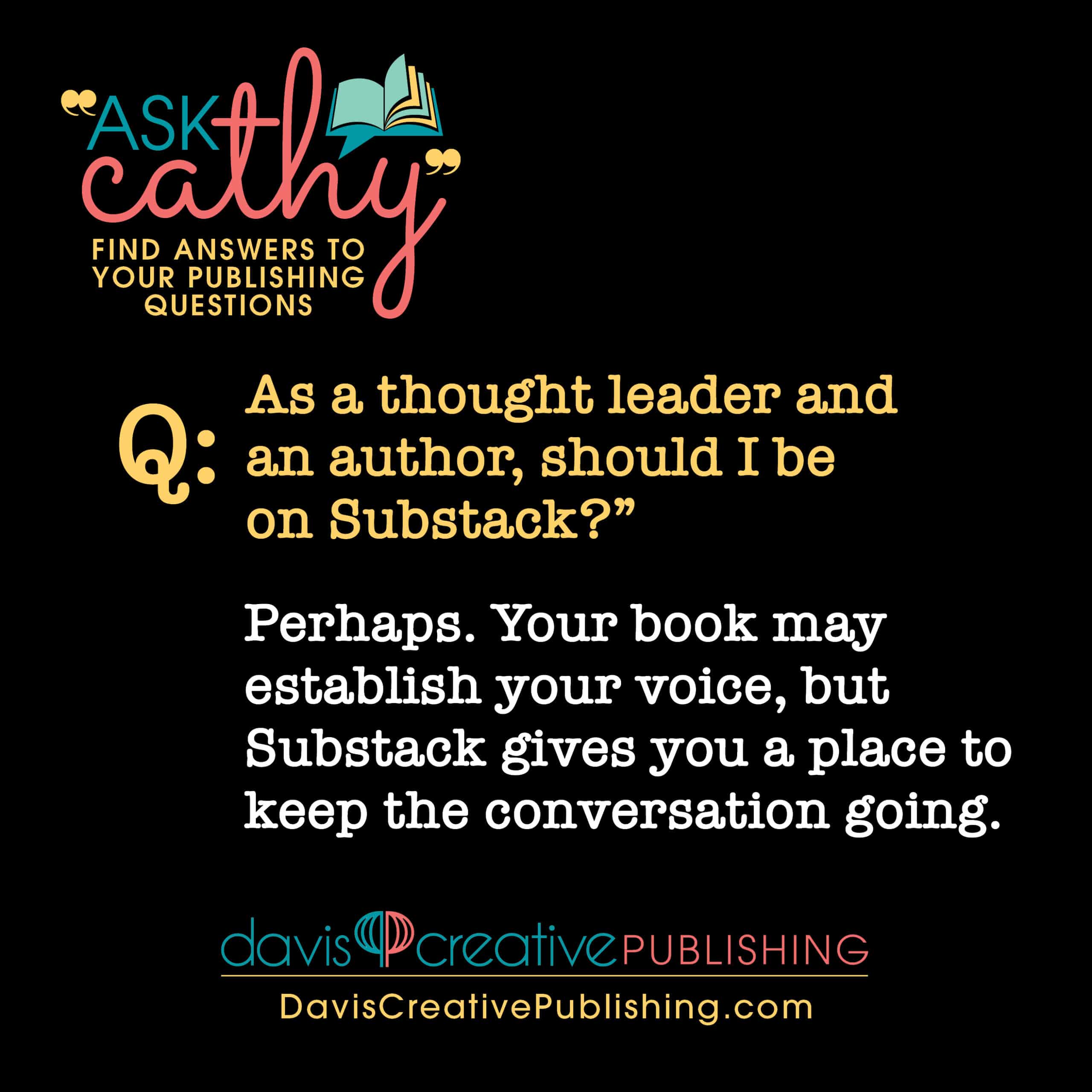
Substack: What Authors and Thought Leaders Need to Know
There’s a new publishing conversation happening, and it isn’t just about books.
More and more writers, authors, coaches, consultants, speakers, and thought leaders are turning to Substack as a way to share their ideas, build an audience, and create a direct relationship with readers.
But is Substack right for you?
Maybe.
Let’s break it down.
FACTS
Substack is a publishing platform designed primarily for newsletters and written content. You can publish posts, send them directly to subscribers via email, and offer some or all of your content for free or behind a paid subscription.
Think of it as a combination of blog + email newsletter + audience community.
And unlike social media, where you are essentially borrowing someone else’s platform, Substack gives you a more direct connection with your readers. Someone subscribes because they want to hear from you—and your content lands in their inbox.
You don’t have to be a technology expert to get started. You can write, publish, and build your subscriber list without creating an entire website or mastering complicated email marketing software.
Substack also gives writers the ability to experiment. You can publish short thoughts, longer essays, serialized content, interviews, commentary, or educational material. You can even use it to develop ideas that eventually become something bigger—like a book.
BENEFITS
So why should an author or thought leader care about Substack?
- It helps you build an audience between books.
A book may establish your authority, but your relationship with readers shouldn’t end when the book is published.
Substack gives you a place to continue the conversation.
Your book can introduce people to your ideas. Your Substack can keep them connected to you.
- It gives you a place to develop your voice.
Not every idea needs to become a book chapter.
Some ideas need to be tested, explored, questioned, and expanded.
Writing regularly on Substack can help you discover what resonates with your audience—and what you have more to say about.
That can become incredibly valuable when you’re deciding what your next book should be about.
- It creates a direct communication channel.
Social media algorithms change. Platforms change. Your followers may never see everything you post.
Email is different.
When someone subscribes to your Substack, they’re giving you permission to show up in their inbox.
That’s a very different relationship than hoping an algorithm puts your post in front of the right person.
- It can support your larger business ecosystem.
For a coach, consultant, speaker, author, or entrepreneur, your content doesn’t exist in isolation.
It can lead readers toward your books, programs, workshops, speaking engagements, consulting services, or other offers.
In other words, your content can become a bridge between your expertise and your business.
PROCESS
Getting started doesn’t have to be complicated.
STEP 1: Decide what conversation you want to own.
Don’t start with, “What should I write about?”
Start with:
“What do I want people to know me for?”
Your Substack should have a clear connection to your expertise, experience, perspective, or message.
STEP 2: Identify your ideal reader.
Who do you want sitting on the other side of the screen?
A potential client?
A fellow entrepreneur?
Women navigating a particular season of life?
Leaders?
Authors?
Your answer will help determine what you write—and just as importantly, what you don’t write.
STEP 3: Choose a sustainable publishing rhythm.
You don’t have to publish every day.
In fact, please don’t promise yourself you’ll publish five times a week if you already know your calendar is packed.
Once a week is plenty.
Twice a month can work.
The goal is consistency, not exhaustion.
STEP 4: Create content from your existing intellectual property.
Here’s where authors have a tremendous advantage.
You already have ideas.
Your book can become a source of dozens of Substack topics.
A chapter can become an essay.
A story can become a lesson.
A framework can become a series.
A question from a reader can become a post.
You don’t always need to create something brand-new. Sometimes you simply need to look at what you already know from a new angle.
STEP 5: Invite people into the conversation.
Don’t simply publish and disappear.
Ask questions.
Invite responses.
Encourage readers to share your posts.
Use your other communication channels to let people know when something new is available.
Your goal isn’t simply to accumulate subscribers.
It’s to build a community of people who actually want to hear what you have to say.
PRO TIPS
PRO TIP #1: Don’t make Substack another full-time job.
Your content platform should support your business—not consume it.
Choose a rhythm you can realistically maintain.
PRO TIP #2: Think “conversation,” not “content.”
People don’t subscribe because they need more information.
They subscribe because they want your perspective.
Your experiences, stories, opinions, lessons, questions, and observations are what make your content yours.
PRO TIP #3: Use your book as a content reservoir.
If you’ve already written a book, don’t let all those great ideas sit between two covers.
Pull them back out.
Expand them.
Update them.
Tell the stories behind them.
Your book can become the foundation for an ongoing body of thought leadership.
PRO TIP #4: Don’t give everything away just because you can.
Free content can build trust, but your expertise still has value.
Think strategically about what you share freely and what belongs inside your paid offers, programs, books, consulting, or other services.
PRO TIP #5: Don’t chase subscribers. Build readers.
A big subscriber number may look impressive.
But 500 people who regularly open, read, respond to, and share your work can be far more valuable than 5,000 people who signed up and never hear from you again.
PRO TIP #6: Let your content tell people what you believe.
Your strongest thought leadership isn’t simply educational.
It has a point of view.
Don’t be afraid to say:
“Here’s what I believe.”
That’s often where the most interesting conversations begin.
THE BOTTOM LINE
Substack isn’t a replacement for your book, your website, your email list, or your social media presence.
It can be something different.
It’s a place to show up consistently, share your thinking, develop your ideas, and build a direct relationship with readers.
And for authors and thought leaders, that’s powerful.
Because publishing a book may establish your voice.
But continuing the conversation is how you keep that voice in the room.